Korea System Assurance, Inc (KOSYAS), a company that provides security testing and evaluation, network and server security, cloud security, IoT security, control system security and blockchain security, has become the first official third-party certifier for OpenChain in South Korea.
KOSYAS support third-party certification around both OpenChain ISO/IEC 5230:2020 (the international standard for open source license compliance) and OpenChain ISO/IEC 18974:2023 (the international standard for open source security assurance).
“The availability of local language support and certification for the OpenChain standards is an important step in building maturity in markets,” says Shane Coughlan, OpenChain General Manager. “We are delighted to welcome KOSYAS to our partner program in the context, and we look forward to building increased support for Korean companies with them in the years ahead.”
As usual, the focus of our main monthly call was a recap of project news and then practical specification development work. Chris Wood, current co-chair of the Specification Work Group (and nominated chair from April 2024 onward) lead a discussion reviewing and editing draft proposals for future versions of our specifications.
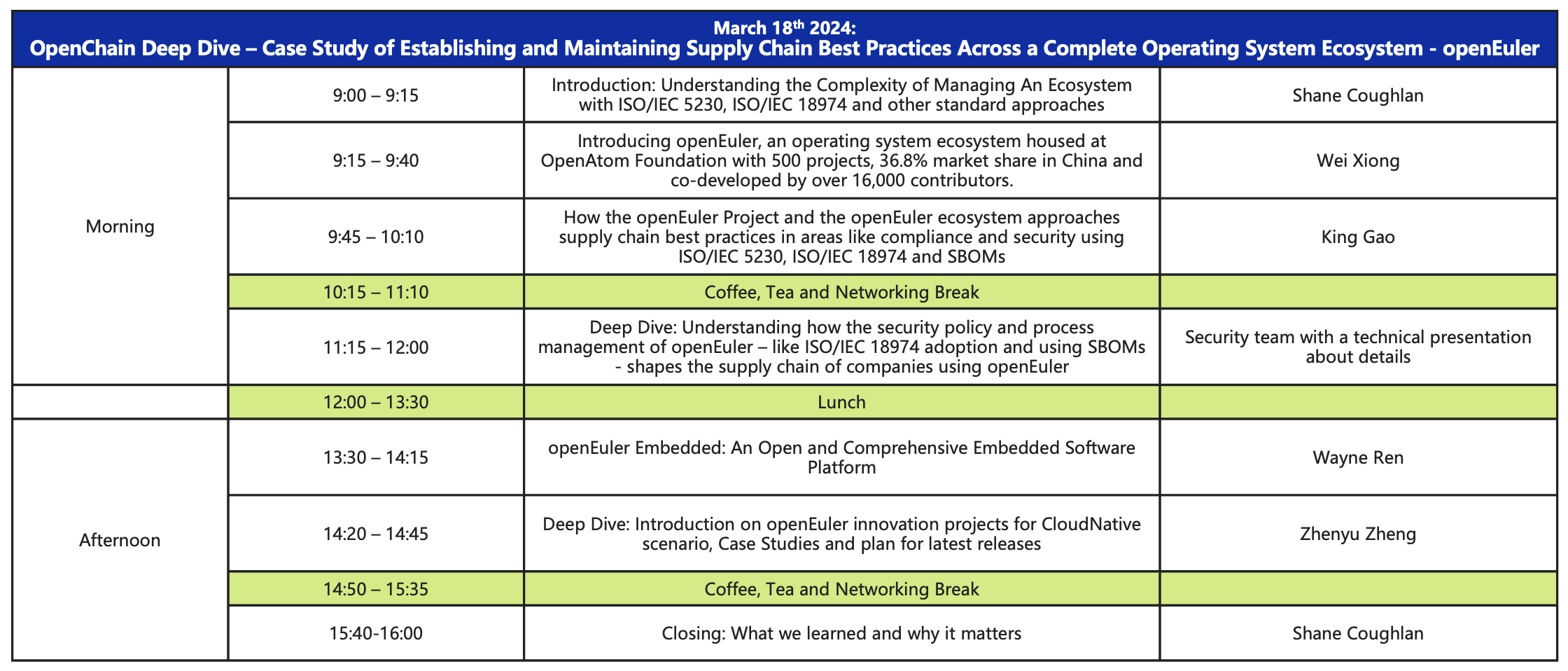
We are holding a special workshop in Shinagawa on March 18th for Japanese companies using open source. This workshop will focus on case studies about open source business process management in China. The focus will be on ISO 5230 and ISO 18974 from upstream project to commercial ecosystem.
We will use an operating system ecosystem called openEuler as the basis for our case studies. openEuler is an emerging operating system ecosystem in China with 36.8% of the server operating system market, 17,000+ developers and 500+ projects. It is hosted by the OpenAtom Foundation, and a healthy ecosystem of companies creating products exists around it. OpenChain ISO 5230 and OpenChain ISO 18974 are at the center of how business processes are managed in openEuler.
This week we have a special AI workshop instead of the regular AI call. It will provide an opportunity to deep dive into the topic with experts from Qualcomm and Arm, and a chance to ask questions or share ideas. This event will fold in all the ideas shared thus far and seek a single coherent narrative.
BlackBerry, an early adopter of ISO/IEC 5230:2020 and OpenChain Security Assurance Specification 1.1 (later ISO/IEC 18974:2023), has completed regular recertification for both standards. The recertification was completed in partnership with OSS Consultants, an official OpenChain Partner, and long-term collaborator in the open source governance space.
ISO/IEC 5230 and ISO/IEC 18974 have a regular recertification process to ensure that open source programs are up-to-date and match current organizational strategy and staffing. Recertification can be done through self-certification, independent assessment or third-party certification on a regular 18 month cycle. The OpenChain Project provides extensive certification support via its website: https://www.openchainproject.org/get-started
“BlackBerry has a long history of cataloging, tracking, and securing its open source components that are bundled as part of its software supply chain. OpenChain has helped us bring together these capabilities and license compliance to have a more holistic open source management process. Having standards like OpenChain is a powerful tool that assures our customers that we take the security and integrity of our software supply chain seriously. As the security community continues to push forward with initiatives like the Software Bill of Materials, companies will need to implement standards like OpenChain to meet the demands of the growing list of customers who prioritize security.”- Christine Gadsby, VP of Product Security at BlackBerry.
“The use of standards like ISO/IEC 5230 and ISO/IEC 18974 provide a strong foundation for companies to manage their open source supply chain. The recertification process is a key part in ensuring processes are current and match products, services and strategy. BlackBerry, as a leader in the field of providing enterprise solutions, is also a leader in software governance and management. Their recertification to our standards for open source license compliance and open source security assurance underlines their stance at the forefront of sustainable, reliable software asset management.” – Shane Coughlan, OpenChain General Manager.
“OSS Consultants is pleased to have partnered with BlackBerry to attain the first whole-entity ISO/IEC 5230 conformance in North America in 2022, the first whole-entity ISO/IEC 18974 conformance in early 2023, and again now to perform the recertification of both standards. This recertification for BlackBerry demonstrates their unwavering dedication to the security and integrity of their software supply chain.” – Russ Eling, Founder & CEO at OSS Consultants
About the OpenChain Project
The OpenChain Project has been building Trust in the Supply Chain Since 2016. Our vision is a supply chain where open source is delivered with trusted and consistent process management information. Our mission is to make that happen. The OpenChain Project has an extensive global community of over 1,000 companies collaborating to make the supply chain quicker, more effective and more efficient. Learn more at https://www.openchainproject.org/
About BlackBerry
BlackBerry (NYSE: BB; TSX: BB) provides intelligent security software and services to enterprises and governments around the world. The company’s software powers over 235M vehicles. Based in Waterloo, Ontario, the company leverages AI and machine learning to deliver innovative solutions in the areas of cybersecurity, safety and data privacy, and is a leader in the areas of endpoint security management, encryption, and embedded systems. BlackBerry’s vision is clear – to secure a connected future you can trust.
BlackBerry. Intelligent Security. Everywhere.
For more information, visit BlackBerry.com and follow @BlackBerry.
About OSS Consultants
OSS Consultants is a business dedicated to helping organizations of all sizes – from the world’s largest and well-known companies to small businesses and start-ups – design, implement, and manage the most efficient, comprehensive and robust open-source program offices and policies on the planet. Service offerings range from a scan and audit of your third-party and proprietary software to creating a full OSPO within your organization. Find more information at www.ossconsultants.com and follow @OSSConsultants.
This meeting focused on closing two open issues around the Licensing Specification (ISO/IEC 5230) as we prepare a proposed update for the Steering Committee:
The latest OpenChain AI Study Group meeting was hosted by our co-chair, Matthew Crawford of Arm. Check out the full recording and get the slides below.
• Recap of discussion so far • Scope – how to build trust in the open source AI supply chain • What are the “compliance artifacts”? • How do we know they can be trusted? • Discuss use cases • Inbound • Deployment internally • Hosting externally • Distributing externally
Thank you to everyone who attended the meeting. We had some great feedback. Check out the recording here:
Most Important Outcome
We adjusted the review / renewal period for the Security and Licensing specifications from 18 months to 12 months to align with ISO 17021 for certification of management systems. You can see the details as follows:
Security Specification (potential future ISO 18974 update):